

The engineered body
From Olympic tracks to weight-loss drugs, the idea of a natural body is disappearing.

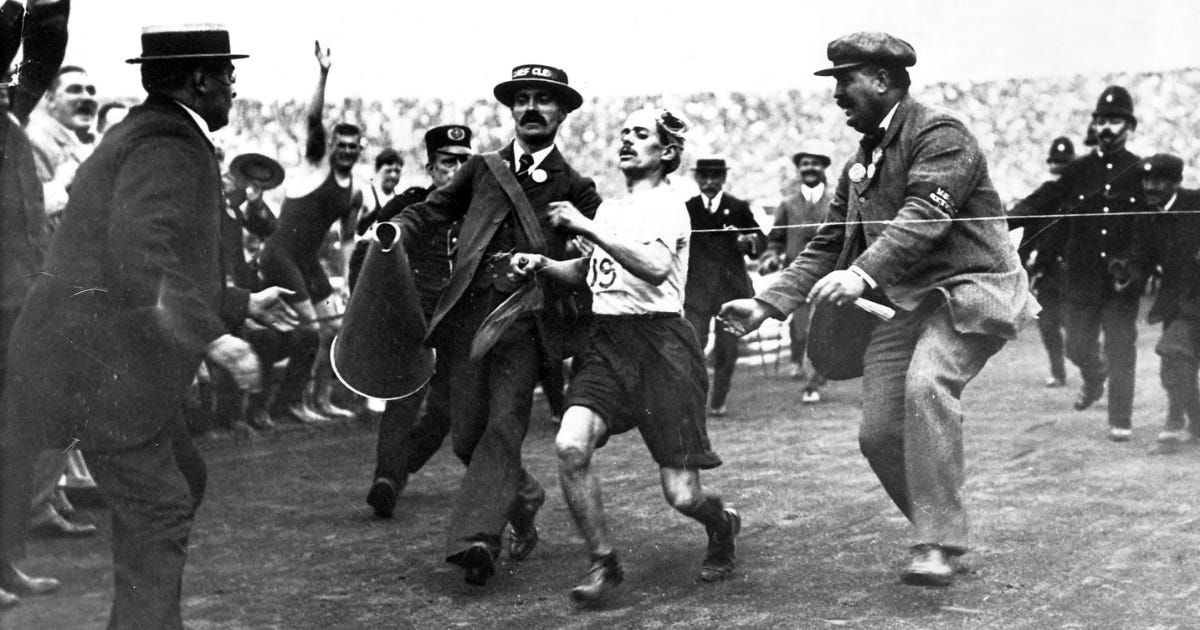
The 1904 Olympic marathon was held in brutal heat, on unpaved roads, with dust clouds choking both runners and spectators. One competitor was given strychnine, a substance commonly used in rat poison, as a performance aid. Several nearly died. It was chaos, negligence and improvisation masquerading as sport.
More than a century later, we like to believe we have moved beyond that world. Protocols are stricter. Testing is more sophisticated. Performances are cleaner. We maintain the illusion of a pristine baseline.
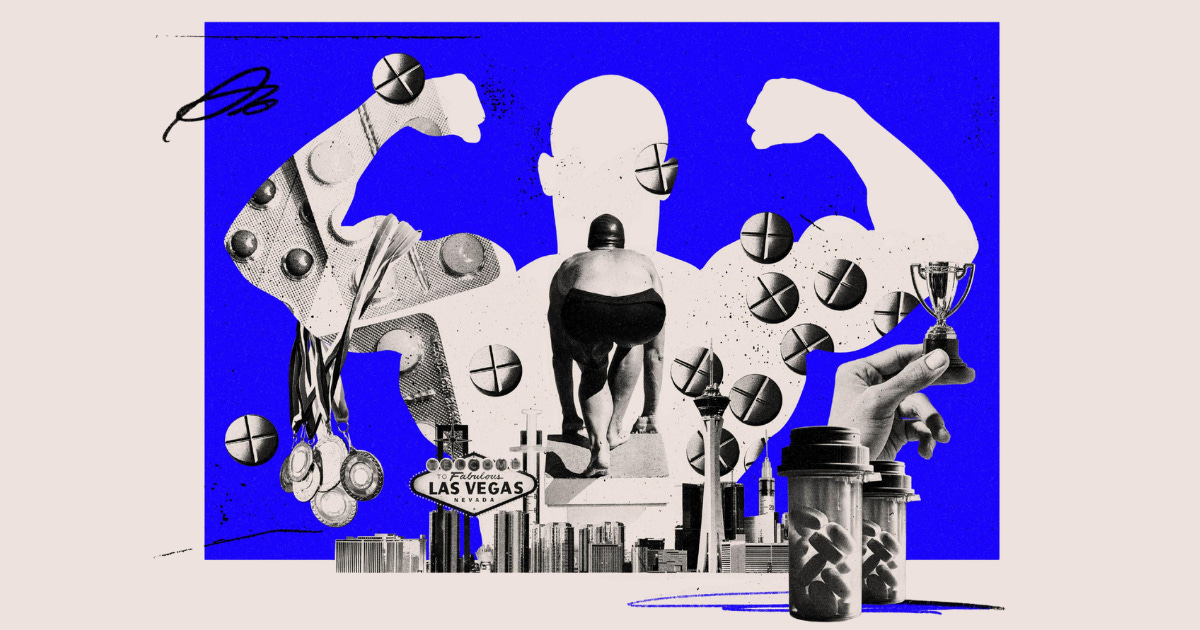
The Enhanced Games arrived in Las Vegas with a 1.2 billion dollar valuation, publicly declared drug protocols and the promise of superhuman performance. In practice, the results were underwhelming. Clean athletes won events and the headline acts failed to dominate. But the outcome was almost beside the point. The narrative had already outrun the evidence.
The stadium was built for more than competition. It was built for a provocation. It asked a question sport has spent decades trying to avoid: is the clean athlete a myth we’ve all agreed to believe?
Keep independent cultural commentary free for everyone.
Negotiating with ourselves
The desire to intervene in the body is neither new nor uniquely sporting. Humanity has long accepted risk in exchange for aspirational reward. Arsenic tonics, coca-infused elixirs and early hormonal experiments belonged to different eras, but all followed the same logic. Performance is never left alone for long.
In the 1970s and 80s, East Germany turned that impulse into a system. Under State Plan 14.25, athletes were given Oral-Turinabol, often without informed consent. Medals followed. Records were broken.
When the Berlin Wall fell, it exposed more than a political regime. It revealed a convenient illusion that sporting excellence could be cleanly separated from scientific intervention. Authorities widely suspected systemic enhancement for years, but enforcement remained inconsistent and politically constrained. Too much depended on maintaining the appearance of fairness.
What has changed since is the language. We no longer talk about doping. We talk about optimisation. It is a word that removes moral weight. You are not cheating. You are improving. You are upgrading.
The new baseline
We now exist in an environment of permanent evaluation. The body is no longer private. It is visible, compared and scored continuously.
René Girard argued that desire is not self-generated, but imitated. We want what we see others wanting. The demand for enhancement propagates socially before it is ever justified individually.
But the deeper shift is structural. Previous eras were defined by aspiration and the pursuit of something exceptional. The current era adds something more insidious, which is a baseline. The pressure is no longer just to excel, but to avoid falling behind. The promise of optimisation is not greatness, but adequacy.
This logic is already embedded in everyday life. Wearable technology tracks sleep, recovery and exertion in granular detail. We wake to scores. We monitor ourselves against dashboards. In doing so, we begin to outsource how we feel to what the metrics report. Health becomes something to manage, optimise and improve continuously. Rest becomes a target. Sleep becomes performance. When the natural body becomes a starting point rather than a standard, enhancement stops looking like a choice. It becomes infrastructure.
The performance of fairness
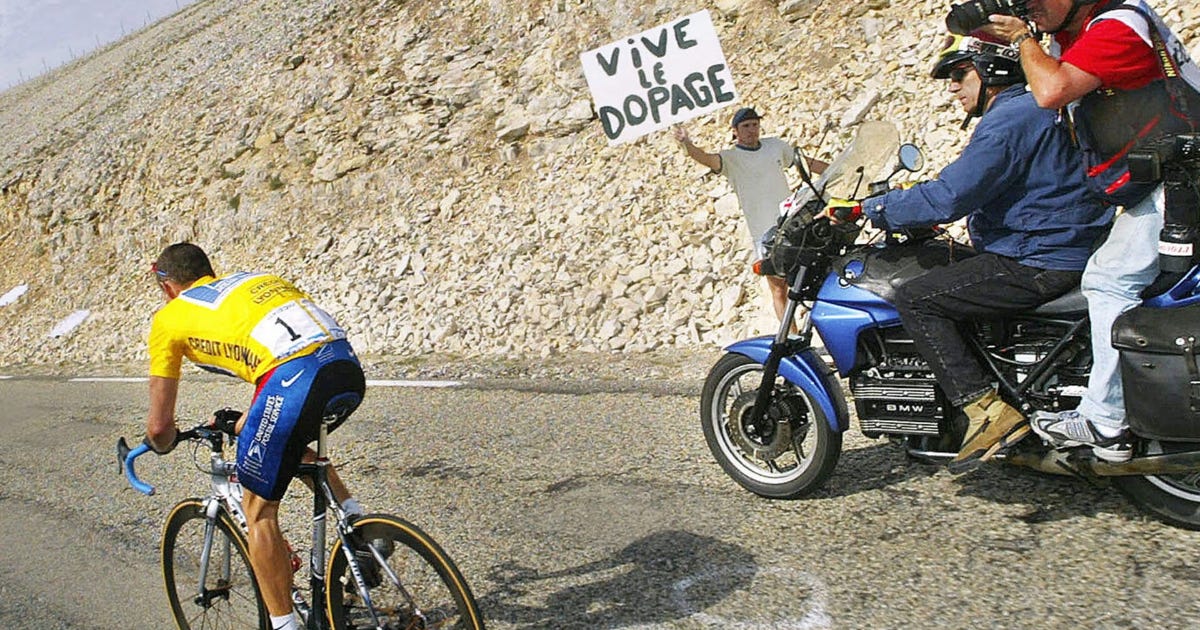
Professional cycling in the late 20th century did not tolerate doping. It normalised it. Riders competed within a system where enhancement was assumed. Substances like EPO were a requirement.
The 1998 Festina scandal exposed the scale of industrial quantities of performance-enhancing drugs, organised and distributed systematically. The sport expressed shock, then continued.
Lance Armstrong’s seven Tour de France victories between 1999 and 2005 were later shown to rest on one of the most sophisticated doping programmes in sporting history. His story was the logical endpoint of the system.
Cycling is simply the clearest case. Similar patterns of denial, protection and eventual exposure appear wherever scrutiny intensifies. Even in athletics, the fastest performances are frequently entangled with doping controversies.
Football operates differently. Testing exists, but scrutiny is lower and medical information remains tightly controlled. Opaqueness persists where visibility might be expected.
Across sports, the pattern is less about enforcement than preservation. Testing regimes, sanctions and ceremonies of fairness do not eliminate the problem. They sustain belief in a system that must appear legitimate to survive.
Normalising enhancement
What is happening in sport is not isolated. It reflects a broader shift in how we understand the body.
The Overton window defines the range of what is socially acceptable. In the context of biological intervention, that window is widening rapidly.
Drugs like Ozempic, developed for diabetes and now widely used for weight management, have moved from medical treatment to lifestyle tool. The boundary between therapy, enhancement and preference has blurred.
Interventions that once felt extreme now feel routine. The natural body begins to look less like a norm and more like an unoptimised state.
In that context, the Enhanced Games are a mirror. They make explicit a logic that already operates everywhere else.
The failure of honesty
The Enhanced Games assumed that their athletes would dramatically outperform the existing Olympic standard. The difference would be obvious. It wasn’t. The margins were small. The gap was ambiguous.
And that ambiguity is the most revealing result of all.
If openly enhanced athletes cannot decisively outperform current elites, we are left with an uncomfortable set of possibilities. Either pharmacological enhancement is less decisive than assumed, or it is already embedded, implicitly, within the existing system.
In trying to create a new category, the Enhanced Games may have revealed that the old one is already saturated. The distinction between clean and enhanced begins to look less like a boundary and more like a requirement of the story itself.
What’s worth saving
Christophe Bassons rode in the Tour de France during the Armstrong era and refused to dope. He spoke publicly about it. He was isolated, pressured and ultimately forced out of the sport. He became a schoolteacher.
His story persists because it represents something we are reluctant to abandon, which is the idea that competition can still mean something.
At local levels, it still does. Where enhancement is absent or negligible, outcomes feel earned, limits feel real and effort retains its meaning.
But at the highest level, that belief becomes harder to sustain. The Olympic ideal promised a shared baseline, a point at which individuals could be measured against one another on equal terms. It was never perfectly true. But it was close enough to believe in.
That belief is now under strain. If the body is no longer a constant, and if its limits are continuously negotiable, then sport changes category. It stops being a contest between people and becomes a comparison between systems. The Enhanced Games did not introduce that shift. They made it visible.
They also exposed the machinery behind it. The supplement pipeline is the actual commercial model. The sport is the funnel. The athletes are the marketing. What looks like a provocation is also a business plan.
The myth of the shared start line
From the rat-poison-laced runners of 1904 to the quantified, optimised bodies of today, the underlying question has never gone away. What are we actually watching when we watch sport?
The Enhanced Games forced that question into the open. The response was predictable. The market rejected it. The institutions dismissed it.
But rejection does not resolve the tension. If elite sport already operates inside a closed loop of optimisation, where pharmacology, technology and training are inseparable, then the idea of the clean athlete becomes a structural function rather than an objective fact. It is something required to sustain belief, justify the spectacle and keep the story intact.
And outside of sport, the transition is already complete. We track our sleep, regulate our weight with drugs and monitor our bodies through algorithms. The logic of optimisation is ambient.
We have always enhanced our bodies. The problem is that we still behave as if there is a stable point before the enhancement begins, a clean standard designed to enable fair competition. There isn’t.
Keep independent cultural commentary free for everyone.
Stay curious. Culture awaits.
Until next time,
George
SO interesting. makes me wonder how far we will take it? so much is normalized today, where will the stopping point be?
Reminded me of Lance Armstrongs insane!
Rat poison is another level